This ID lets you retrieve or verify your consent settings. It stays saved for {0} months or until you clear cookies — keep a copy in case you need to reference it.
AMC89MQ329407NSADRFA09MA7SD
Required
Essential Consent
Off
On
Marketing Consent
Off
On
Analytics Consent
Off
On
Personalization Consent
Properly uses cookies and similar technologies to improve your experience, analyze traffic, and to show you relevant content and advertising.
You can accept all, reject all, or customize your privacy settings.
It's the beginning of 2026. Previous year alone, we've seen stablecoins go institutional, perpetual DEXes explode in popularity, and neobanks racing to launch crypto cards. In this industry, trends shift in months, not years, and regulations can flip your project roadmap in a week or make it unprofitable overnight. Now imagine you've worked on a product for two years. The tech is solid, the platform works, but the market moved on and the narrative changed. What was hot when you started is now crowded or worse, irrelevant.
This is exactly what happened with Eterna.
Not Every Change Leads to Progress
After two years building an advanced perpetual exchange, Eterna had a working product. But the vision had blurred. The team had evolved with new people, new perspectives, and new ideas about where to go next. It was the perfect time to stop and ask: who do we want to become next? That's a situation where most crypto projects find themselves eventually. Finding product-market fit is hard, not from lack of execution but from too many opportunities to chase in this high-volatility market.
Eterna had everything going for them: a working perpetual exchange, integration with Bybit giving them real liquidity, and a team full of ideas. But ideas without clear direction become another meeting, another exploration, and eventually just losing momentum. This is the story of how they took two years of work and turned it into a new product in seven months - not by starting over, but by stopping first.
The Problem Nobody Wanted to Admit
"Good thing we found Properly," said Piotr, Eterna's CEO, during a strategic workshop in our Warsaw office. It was a good sign that people involved in the project recognized that something needed to change. It's also worth pointing out that our collaboration with Eterna was never a standard agency-client setup - it was more like a partnership. We'd already worked with Eterna for a while, helping them redesign their existing platform and building a design system that streamlined the interface and visual language. That foundation would become crucial later.
But first, what they needed now was a shared vision and a structured way to validate ideas together.
What Eterna had built
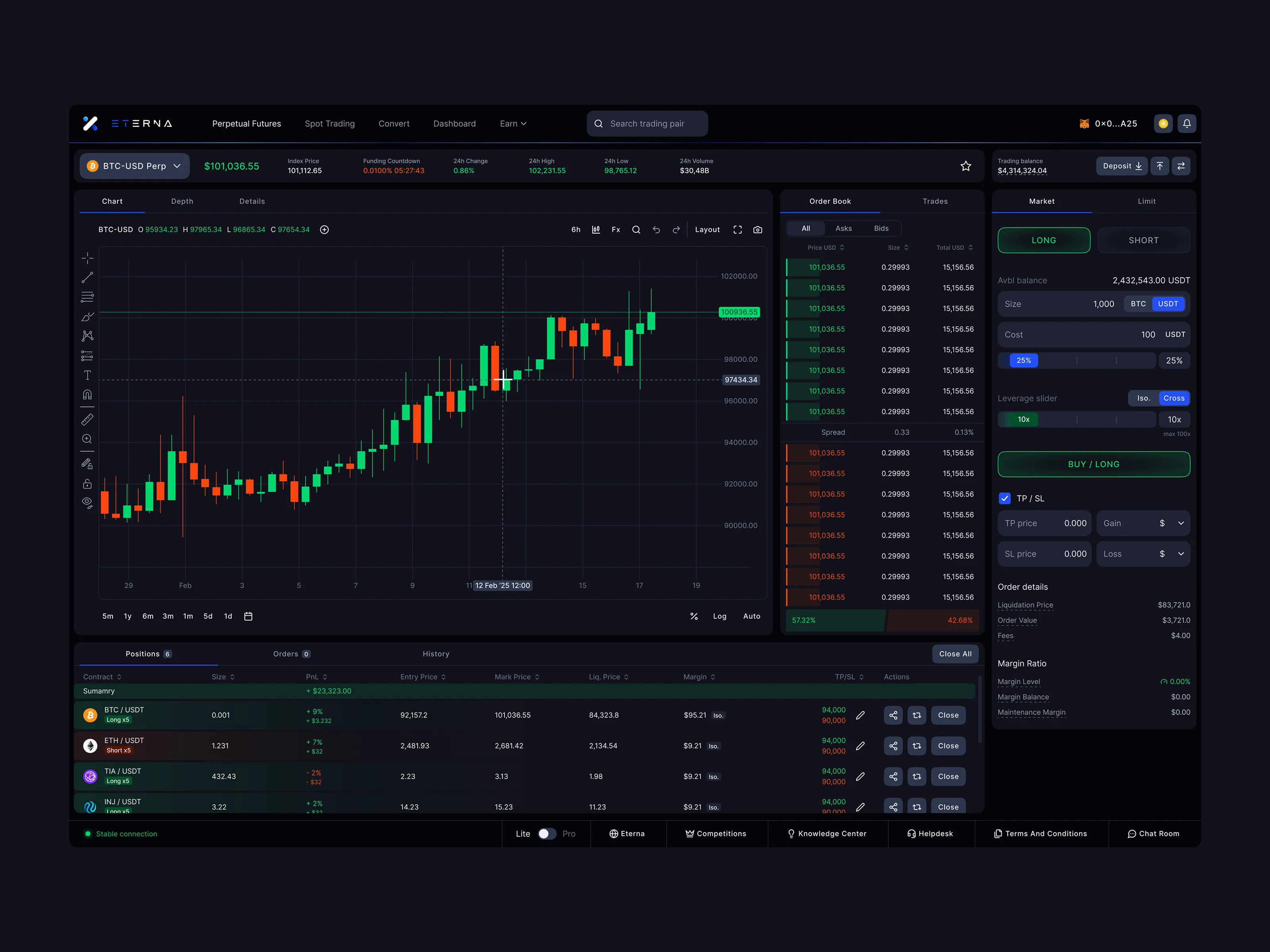
Eterna builds perpetual trading platforms, tools that let traders speculate on crypto prices with leverage. Their main product combines CEX-level performance with DEX-level freedom: no KYC, full custody, real autonomy. The product worked. The tech was solid. But the market they were chasing (professional traders who wanted maximum control and complexity) was narrow, competitive, and crowded with platforms like Hyperliquid, Lighter, and Aster.
The advantage they already had
Before we go further: Eterna wasn't starting from zero. They had something most DEXs spend years chasing: real liquidity. Their integration with Bybit, one of the largest exchanges in the market, gave them the kind of depth that makes or breaks a perpetual platform.
In the world of perps, liquidity is everything. It directly impacts a trader's success: tighter spreads, less slippage, better execution. Without proper liquidity, a sudden price swing can trigger your stop-loss even when the broader market moved just slightly. You end up exiting positions not because your thesis was wrong, but because the platform couldn't handle the order flow.
Most DEXs struggle to bootstrap this. Eterna already had it.
The Workshop Where Everything Clicked
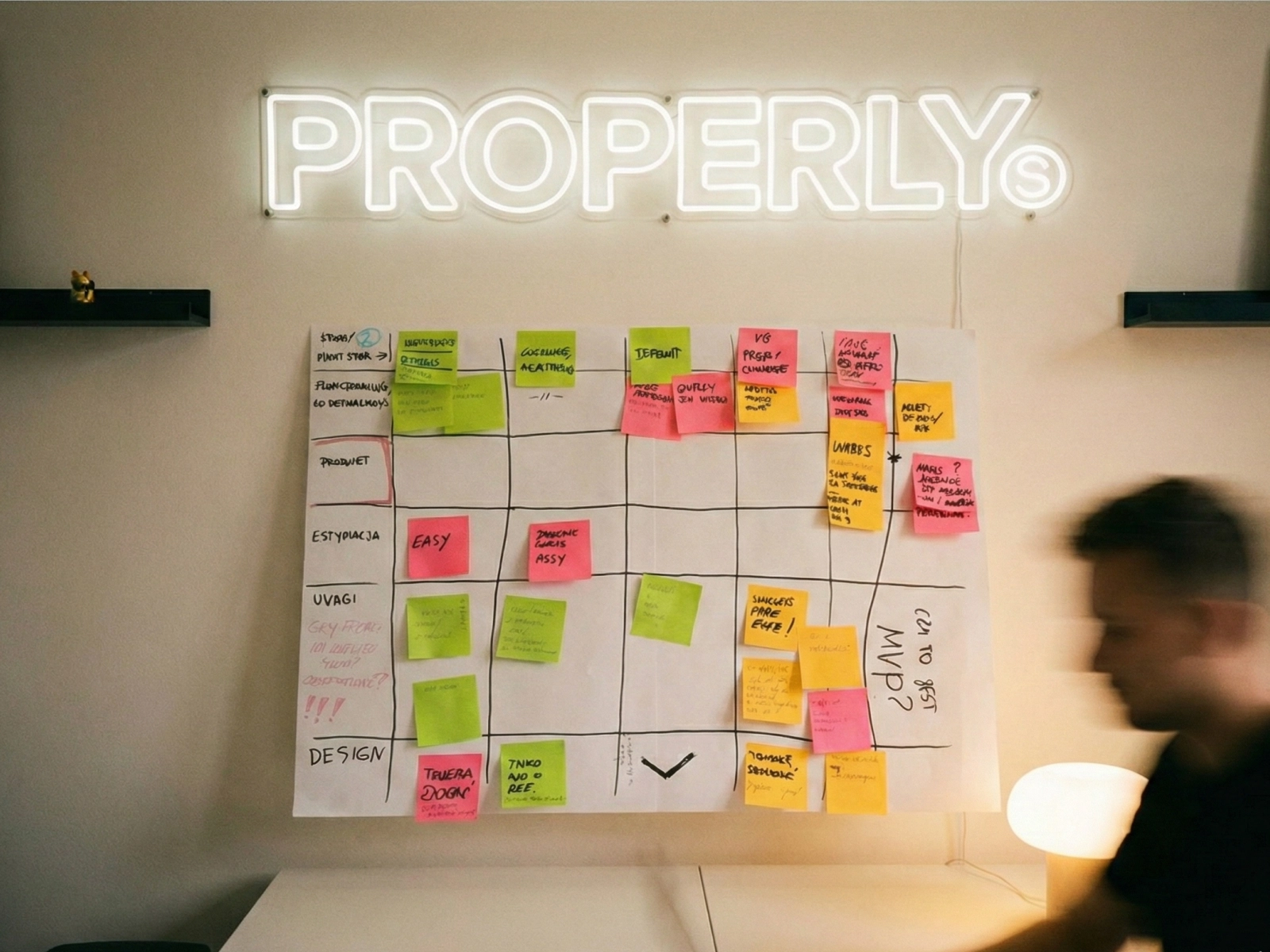
We organized a joint workshop where for the first time all the new Eterna's team members could meet, in person. The goal wasn't to design features. It was to rediscover alignment, define what the product should truly become and plan long-term strategy. Ideas were flying - some focused on gamification, others on retail onboarding. Someone even threw out "Tinder for traders" at one point (yes, really). Getting fresh perspectives is valuable, but they were pulling in different directions. Without alignment, every meeting might become another exploration instead of execution.
Over two days, we combined UX methodology with Properly's crypto domain expertise and Eterna's product knowledge through three core exercises: personas to define who they're building for, user journey mapping to understand the full experience, and a prioritization matrix to decide what to prioritize to accelerate development while allowing the most important features to mature properly.
The breakthrough
We came to the conclusion: there's an entire segment of younger, less experienced users who want to trade perps but find existing platforms complicated and not really UI-newbie friendly. Every perpetual platform looks the same. Built for professional traders (or points farmers) with years of experience. These younger users already interact with apps that feel intuitive, approachable, modern. They understand gamification. They respond to interfaces that don't assume expertise upfront. During the workshops, the term "Eterna Light" came up. But that sounded like just a stripped-down version of Eterna Pro. We went a step further.
Eterna realized they could build something different. Not a "lite version" of their advanced product, but a separate platform for an entirely different market - easy to understand and fun to play with.
Building the New Eterna
Recycled content that saved months
We weren't starting from scratch. During our collaboration with Eterna, we'd built a comprehensive design system: components, patterns, interaction models, all documented and ready to use. We just needed to adapt it to the new visual language.
This is what design systems are supposed to do: let you move fast without compromising quality. Instead of reinventing basics, we focused on what actually mattered - the new features and flows for beginner traders.
With shared priorities and smoother communication, the development cycle became clearer, faster, and more focused. Eterna also opened up to a new segment of users — beginner traders who had previously stayed away from perps due to complexity and risk.
What made the new Eterna different
Traditional perp platforms assume the user knows what they're doing. Every interface looks like a Bloomberg terminal: charts, order books, leverage sliders, margin calculations staring at you from the moment you land.
Perfect recipe to scare off your new users. The new Eterna simplified the chart interface to make it more understandable for the newcomers:
Leverage is translated into risk level
Simplified line chart with clear buy/sell signals
Reduced order options to default market price
Why Pivots Are Hard (And Why This One Worked)
Everyone talks about staying flexible and adapting to feedback. But when it's time to actually change direction, it's definitely easier said than done. Plus, pivots demand something harder than building: letting go. The longer you build in the wrong direction, the more expensive it becomes to turn around. Adding features to fix adoption problems. Rebranding to mask strategic confusion. The teams that avoid pivots don't save time. They just postpone the inevitable.
Eterna chose differently. Instead of adding more features to a struggling product, they paused and brought in outside perspective. They made a decision most teams avoid: choosing a smaller, clearer target instead of trying to be everything to everyone.
What made this pivot work
Eterna made a strategic bet: there's a market for perpetual trading that doesn't look like every other perpetual platform. A market of younger users who want access but need a different approach.
The seven months got them to launch. The real validation comes next: user adoption, retention, feedback loops.
But what they have now that they didn't have before:
A clear target audience instead of "everyone"
A product built specifically for that audience
The infrastructure to iterate fast based on what they learn
A team aligned on what they're building and why
The Lesson You Can Learn From this
Eterna's story is about making the hard call - stopping when everyone else doubles down, reassessing when momentum says keep building. In crypto, where trends shift monthly and narratives change overnight, that kind of strategic patience and bravery is rare. But there's also the risk of shipping something too late. Finding that balance is the hardest part.
Eterna's team stayed deeply involved throughout the process. Decisions happened in days, not weeks - sometimes even too fast, but that’s the industry. When something wasn't working, we changed it immediately instead of waiting for the next checkpoint. With a shared Slack channel and weekly meetings, communication went smoothly and decisions were made quickly. If some topic needed graphic exploration or brainstorming, we were always there. Other designers could hop in if needed.
If we were asked what made it happen, we would point out three main things:
Clear strategy from the workshop - no second-guessing the direction
Reusable foundations from earlier work - no reinventing basics
Tight collaboration loop - fast decision-making that kept up with change
If your product is stuck between what it was and what it should become, maybe it's time for a workshop.