This ID lets you retrieve or verify your consent settings. It stays saved for {0} months or until you clear cookies — keep a copy in case you need to reference it.
AMC89MQ329407NSADRFA09MA7SD
Required
Essential Consent
Off
On
Marketing Consent
Off
On
Analytics Consent
Off
On
Personalization Consent
Properly uses cookies and similar technologies to improve your experience, analyze traffic, and to show you relevant content and advertising.
You can accept all, reject all, or customize your privacy settings.
We Gave AI 14 Hours to Replace Us. Here's What Happened.
Three teams, one biometric fintech product, and one honest question underneath it all: can this stuff actually replace the work we sell to real clients?
Yes… and no. Let me explain: it carried us through 80% of a concept in 20% of the time, surprising even the people who touch AI every day.
Then it slammed into a wall so hard that ignoring it would have wrecked the entire result. That wall is exactly where a lot of founders are quietly bleeding money right now, and it's the reason a human still sits at every single stage of our process.
If you're shipping an AI-generated MVP and feeling like you're one click away from a real product, read to the end. That last part is going to save you.
Why a design studio runs an AI hackathon
We're mostly product designers and brand designers. Most of the team had never been a hackathon participant before, or built their own tools. We wanted to test, together, what AI is genuinely capable of, what you can build with it, and where the ceiling actually is today.
The push behind it is obvious if you've spoken to a client in the last year. Everyone is drunk on AI. Everyone assumes that asking a model anything gets you a valuable answer back. And in doing that it inflates every idea, even the cleanest and most minimal one, into a complicated tank that nobody wants to drive.
And as product designers, we understand the real problem with that better than most. AI can deliver an enormous amount of value. But you need the right mental models to check whether that value is actually positive, because the tool has one dangerous habit.
It never tells you to stop.
What the day actually looked like
Three teams. Each one had to build a product, a biometric fintech app. The product itself and the logo were set beforehand, and they weren't the point. The point was how each team approached every stage, from brand all the way to the final visual of a clickable MVP prototype.
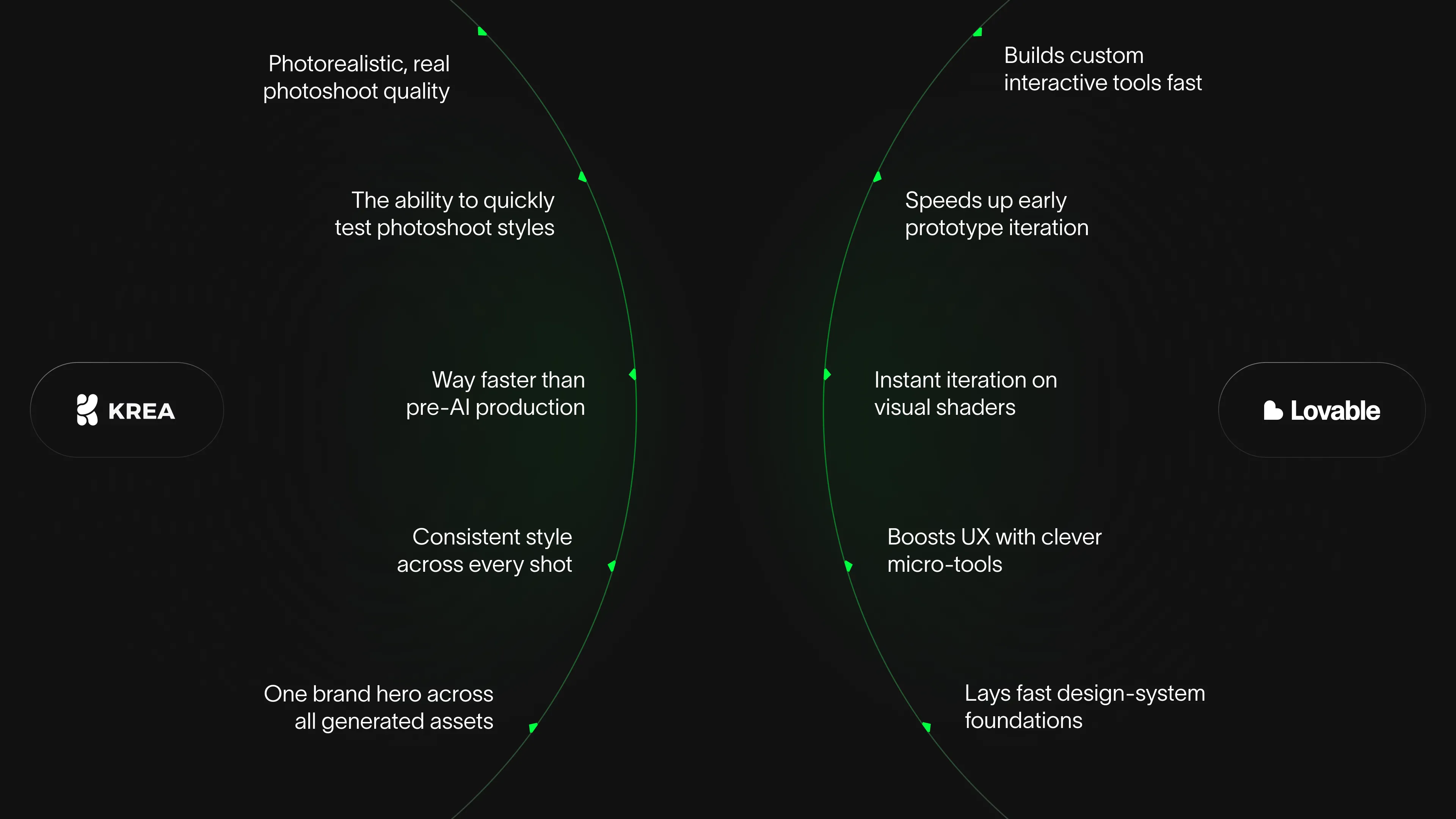
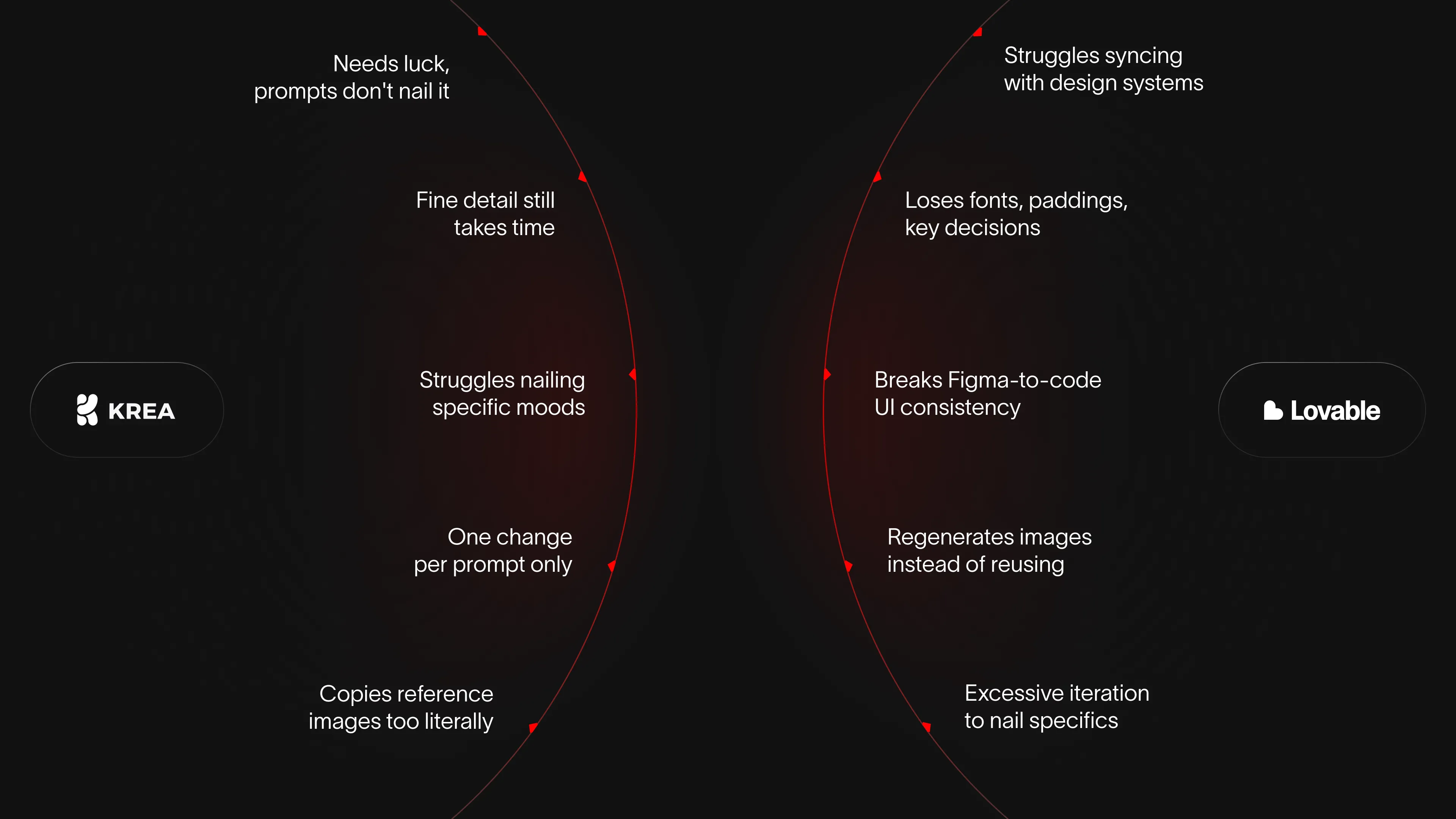
We opened with a short intro. Tom showed how to work with Krea, I showed a bit of Lovable. Lovable turned out to be a fun toy for the vibecoders in the room, and honestly weaker as real support for a product designer working with an actual client instead of building their own little side project.
What came out of it was three completely different concepts. That's the part I keep coming back to. A small multidisciplinary team can produce a real, quality concept in a single day, something you can genuinely keep developing afterward. Straight Pareto: in 20% of the time we delivered 80% of the quality.
What the results looked like
Same brief, three completely different products. Here's what each team actually built.
Project: Scion
Built around widening circles of trust: you first, then you and a partner, then closest family, then friends. The visual direction leaned into something raw on purpose, wrinkles, dirt under a nail, the kind of detail you'd normally retouch away. It read like childhood, like the closeness you don't have to explain.
Project: Innate
Built around the eye. Everyone's iris is genuinely one of a kind, so the team designed a terminal you just look into to confirm a payment. No card, no phone, no gesture, just eye contact with the machine, and it's done.
Project: Pulse
Went further out: Neuralink as the backend, VR glasses as the front end. Think about buying something, or confirming a payment, and it shows up right in your field of view. Paying becomes something you do by looking at the world, not by stepping out of it.
Where AI pulled its weight
The brand and visual side is where AI earned its keep. Generating consistent graphics and photography, holding a coherent visual direction, mocking products up in real-world settings fast. We can run a photo session without a photographer and without a studio, using tools like Krea or Weavy, and get usable results.
The gap between disciplines shrinks too. Anyone with an idea can build themselves a tool, a shader, a pattern generator, whatever they need, and control any effect they want, motion or 3D. During the hackathon, teams built exactly these kinds of tools in Lovable, things that let them create 3D, animated, fully interactive solutions. That used to require developers and a serious investment of time and money. It happened in an afternoon.
AI also has real weight at the discovery stage. Give it the business context of your user and solid UX practice, and it helps you plan the product and focus on the right behavioral and business elements. It's a great partner for bouncing ideas around. And that's the ceiling of where I trust it: as a partner for thinking, at the whiteboard, in that first exploration phase.
Where AI fell apart
AI was solid for prototypes and for that first pass of UX exploration. It fell flat the moment we wanted something with a real point of view, an interesting, cohesive UI. To stand out at any stage of the process, you still need a human, from the idea and business strategy through the UX approach to the visual direction. Trust AI completely at any of those levels and you get slop.
That's the uncomfortable part right now: you can't deliver quality service, or get more value out of any stage of a design process, by swapping a human for a machine. Not today.
I want that to land without being misread though. This isn't us boycotting AI. We explore it hard and keep our hand on the pulse, because updates ship constantly, the horizon shifts, and we get new toys to play with every few weeks.
The real test: what clients send us now
We used to get a brief. Ideas written out at varying levels of depth: business strategy, an approach to the user, technology. Now more and more clients chat freely with AI and get a clickable MVP spat out the other end. In theory it's one step from a working product. In practice, if you focus only on that artifact, it's usually AI-slop at every level.
Assume the founder has real business and domain knowledge. Fine, then we don't have to worry that the prototype was thought through commercially. But the world doesn't have many unicorns who know everything. So the prototype can be smart on business and completely fall apart on UX, on visuals, on the tech underneath.
We work in crypto and fintech, and we watch how fast that space validates ideas. A lot of projects live for a year, and let's be honest and follow the money: nobody actually wants that. Everyone wants a product built to stay with users for years and keep the cash flowing for founders and investors. And that still needs a full design process. The process evolves, the tools change, but the mental model we move through doesn't.
The tool stays a tool
So here's where I land after a fourteen-hour day: AI became a genuinely great partner for bouncing ideas, exploring, and moving faster than we could a year ago, but it's not an execution layer. The second you hand it the final decision on quality, you get generic output that looks like everything else on the market.
This was our first hackathon and our first phase of exploration, and we already know from other work that AI can go much deeper when you drive it properly, using something like Claude Code, leaning on skills, building design systems directly in code, designing inside the repository itself.
For our retainer clients, that's already the present. When a client has a large, mature design system and a locked visual direction, and you only need to add the next flow or the next feature on top of components and styles that already exist, this is genuinely powerful.
The value keeps arriving. We keep grabbing it. But at every stage that matters, from strategy to the last pixel, there's still a person deciding when to stop. AI never will.